Every story starts somewhere. This one begins in the back of a '69 Buick.
I'm John Michael Lockhart. In 1972, I conducted my first oral history interview, which spanned the better part of a two-hour car ride east to west across south Louisiana. My narrators were two of my maternal grandmother's aunts, Lottie Mixon, 67, and Mildred Harrison, 72. I was nine.
Seated between them in the back seat of my grandparents' 1969 Buick, I quizzed my aunts about their childhoods, the Roaring Twenties, and the Great Depression. They also spoke candidly about how the two world wars upended their lives.
My aunts shared their lived experiences with me because I took the time to ask. Their responses enhanced my understanding of those historic events through their eyewitness testimonies and personal reflections, bringing me face to face with the lingering cost of two wars—the first, which made Aunt Mildred a widow, and the second, which made her a Gold Star mother. Their husbands died young, leaving Aunt Mildred with five children and Aunt Lottie with three children to feed and clothe.
Employment opportunities for women in that era were limited; they became nurses, but the pay wasn't good, and their options were few.
The seven decades that spanned Aunt Mildred’s birth in March 1900 to our Saturday morning excursion were the most transformative period in all of recorded human history. She was three when the Wright Brothers made their first motor-powered flight and sixty-nine when Neil Armstrong and Buzz Aldrin left their footprints on the surface of the moon.

In seventh grade, I was selected to attend a gifted writers' summer workshop held at Louisiana State University in Baton Rouge. The program was modeled on Foxfire, the student-led magazine and book series, founded in 1966, that documents the folklore, traditions, and oral history of Southern Appalachian life. Building on that early experience, I spent that summer interviewing the eldest members of my church about their childhoods, community life, and church life in the 1890s and early 1900s.
My passion for storytelling continued as a high school student journalist, where I secured interviews with radio and television icons Paul Harvey and Art Linkletter for my high school newspaper.

In 1994, capitalizing on my passion for conducting oral history, I launched a community weekly. Though my grandparents lived 35 minutes away, I made time to visit them three days a week. On Valentine’s Day 2013, seven months before my grandmother died, I received a press release announcing Louisiana’s "Top 10 Longest Married Couples." Ed and Hilda Guedry, married for 73 years, lived in my newspaper’s circulation area and made the list. I interviewed them that afternoon. Mr. Ed was a WWII veteran and an avid golfer, best known for making miniature birdhouses. Mrs. Hilda was a budding artist and computer-savvy; we became Facebook friends. Whenever Mr. Ed made banana nut bread, Mrs. Hilda would invite me over. He died on New Year's Day 2015, five weeks shy of their 75th wedding anniversary. She died on Valentine’s Day, two years to the day after I met them.
Two more couples in my newspaper's circulation area made the "Top 10" list for the first time on Valentine's Day 2015. Jack and Felicie Rogillio of Rosedale, LA, made the list in 2015, 2016, and 2017. Charlie and Rita Serio of Morganza, LA, appeared in 2015, 2016, 2017, and 2018. Collectively, these three couples were my last link to my grandparents’ generation—the Greatest Generation.
While the Serios and I discussed Mr. Charlie’s WWII service, Mrs. Rita revealed that they wrote to each other daily. He hadn’t saved her letters, but she had kept his. No one else—their children included—knew the letters existed. Seven hundred letters Mr. Charlie wrote over his 26 months in North Africa and Italy had been safeguarded in a Lucky Strike cigarette box on the top shelf in their bathroom closet for seven decades. With their permission, I grabbed a step stool and retrieved the hefty box.
Mrs. Rita had organized her husband's wartime letters by date, binding each stack with a string. These letters provided an intimate look into Mr. Charlie’s thoughts and daily life as a soldier abroad.

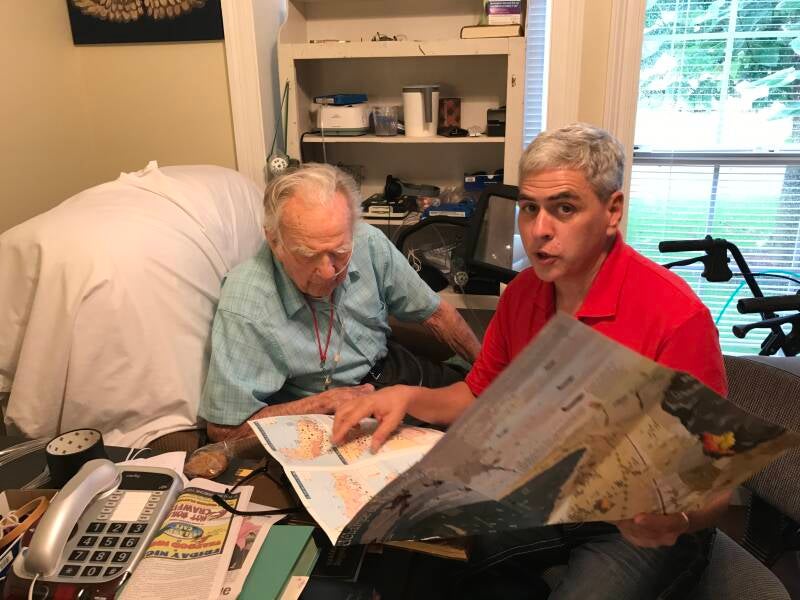
Like Mr. Charlie, Mr. Jack was smitten with Mrs. Felicie the first time he saw her. Like Mrs. Rita, Mrs. Felicie was not impressed. Years later, they met once again on a double date. They eloped on a Wednesday night and exchanged vows in a police station during the 11 p.m. shift change. "We've had a storybook marriage, but we didn't have a storybook wedding," Mrs. Felicie joked.
While stationed in England, Jack volunteered to become a paratrooper because the pay was better and he needed every dollar. He parachuted into occupied France on D-Day and fought in the hedgerows of Normandy. He made a second jump into Holland and battled his way up the ‘Hells Highway’ in Operation Market-Garden. Mr. Jack was one of the ‘Battling Bastards of Bastogne’, surrounded by the Germans at Bastogne on Christmas 1944, in the Battle of the Bulge. He spent the last day of WWII kicked back in Hitler's bed, drinking liberated Nazi booze, at Kehlsteinhaus (Eagle's Nest), the führer's mountaintop retreat.
According to Mr. Jack, the 101st Airborne had 222 men when the D-Day invasion began and only 60 men when the war ended 11 months later.
During their 76 years of marriage, the Rogillios lived in more than 40 homes in diverse locales: Houmas House plantation, a dairy farm in Arkansas, Indonesia (with a household staff of five), and the Philippines.
“We used to say, ‘when the carpet gets dirty, we’d move,’” Mrs. Felicie said.
On the Saturday of Memorial Day weekend 2015, I paid the Rogillios a surprise visit. With me were two boys, ages ten and eleven, and two girls, both eight. I was taking the kids to the Heartland Fair in Lafayette, LA, but before that fun began, I wanted them to meet a real hero of World War II.
The kids, especially the ten-year-old boy, Christian Fluker, were glued to every word Mr. Jack shared with them about his military service. Until Mr. Jack’s death, Christian regularly asked me about him.


On May 15, 2017, I arrived at the Rogillio's home with some news: I was headed to France the following morning to visit Sainte-Mère-Église, the French town Mr. Jack helped liberate as a D-Day paratrooper. They had news for me, too: Mr. Jack had entered hospice care.
Shocked, I canceled my trip and called my congressman's office to request that two American flags be flown over the U.S. Capitol for two World War II heroes who had been married to their wartime brides for 75 years or more.
On May 17, I returned to the Rogillios’ house with the Serios. While Mr. Jack and Mr. Charlie swapped war stories and Mrs. Felicie and Mrs. Rita talked about their families, I sat back and thought about just how blessed I was to witness these four amazing people interacting. What began as two spurned schoolboys and two unimpressed schoolgirls nine decades earlier had evolved into 151 years of marriage.
I had just landed in Boston in late July 2018 when I received the phone call that Mr. Charlie had died, and Mrs. Rita would be moving in with her daughter.
In September 2019, the community weekly I launched in 1994, celebrated its 25th anniversary, and I began doing a soul-searching. The desire to look back on your life and find ways you left the world a better place is a common human want. I started my community weekly with that as the primary purpose, and I could point to many ways that I had succeeded. But the newspaper industry had been dying for a dozen years, and I didn’t have the fire in my belly for it anymore. I needed a new challenge, one that would allow me to serve a greater good in a much bigger arena.
My one great passion was conducting oral history; I’d been doing it since I was a little kid, and I knew how it had transformed my own life.

There was also something else I knew. Research shows that children who know where they come from — who understand their family's history, its hardships, and its victories — are measurably more resilient. They perform better in school. They handle adversity with greater confidence. They develop a stronger sense of identity and belonging because they understand that they are part of something bigger than themselves.
That's the power of a strong family narrative.
After a friend three years my senior died in November 2014, on the same day I was returning from a trip to Argentina, I pledged myself to spend the next three years travelling the world with three specific goals: spend at least 100 days a year travelling, visit at least a dozen countries a year, and sleep on all seven continents in under a year.
My friend Jim Brown, a former Louisiana Secretary of State and state Insurance Commissioner, had formed a publishing company. Jim and I would have lunch a few times a year, and my travels were always part of the conversation. Jim wanted me to write a travel journal, but that didn't interest me. My friend Caroline Kennedy, screen icon Bette Davis's live-in personal assistant in the 1980s, was also pushing me to write a book. When Caroline was diagnosed with an aggressive form of ALS in early 2022 at age 61, I knew exactly what I would write about.
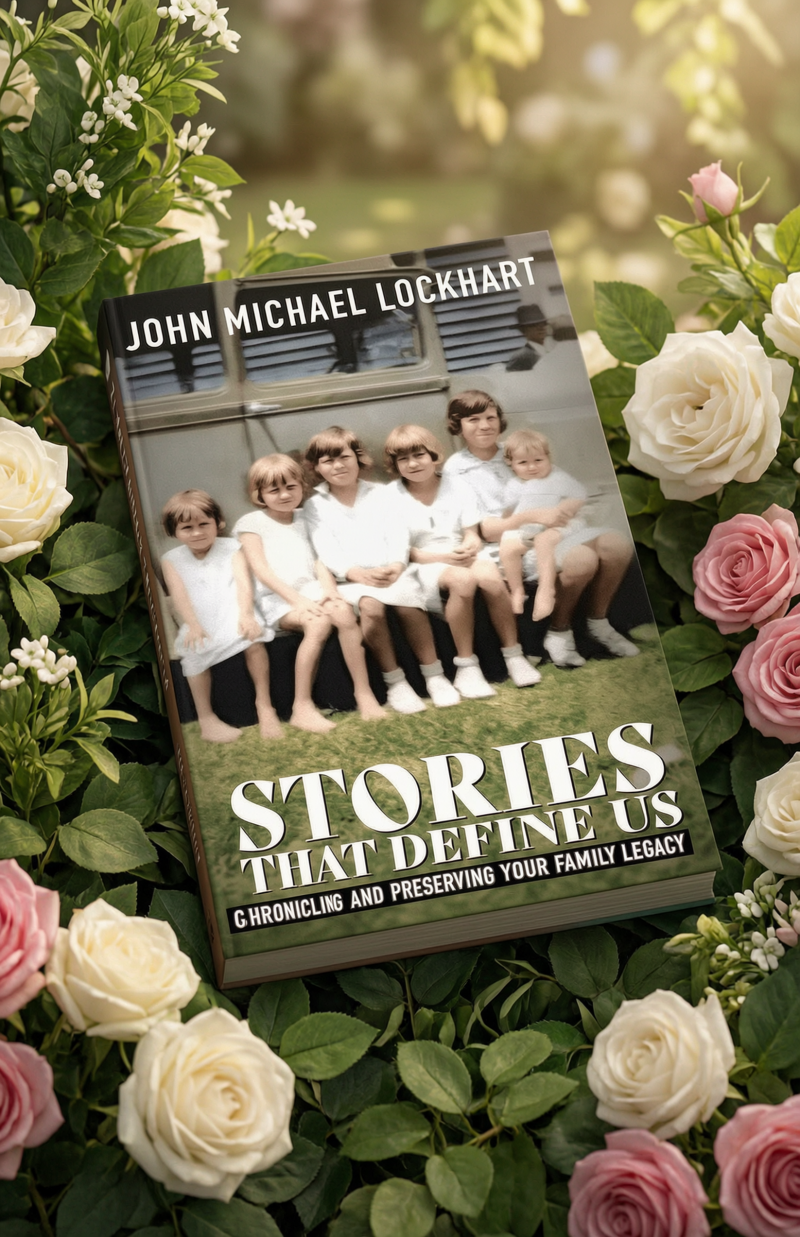
Life is short; we never know what tomorrow might bring. My how-to book, filled with human interest stories from people from all walks of life, STORIES THAT DEFINE US: Chronicling and Preserving Your Family Legacy, reminds us how important it is to record our family history for ourselves and the generations yet to be born.
"John Michael, these past two weeks have been a time for healing in my family, and we have you to thank for that. Your beautiful article, "Healing Hands", has meant so much to my mother, my brother, and me. The people in our community knew what we- and especially our mother- have gone through, but they were reluctant to speak out. Your article changed that, and they have embraced my mother. Thank you for sharing our story with care and dignity...."
Barbara Raub • Morganza, Louisiana